Highlights
- One-day private tour from Seoul to Gyeongju
- Visit the nation’s most popular field trip destination
- Experience the greatest Buddhist art treasures in Korea
- Taste the famous and unique Korean dish Ssambap
- Explore a whole city famous for being a UNESCO World Cultural Heritage site
- Know more about the important and rich history hidden in every corner of Gyeongju
- See for yourself the beauty of ancient architecture and how it blends with the surrounding nature
Minimum travelers 2 Duration 1 Day
Overview
Located in southeast Korea, the city of Gyeongju was once the capital of the Silla Kingdom, the longest surviving kingdom in the history of the peninsula, for almost 1000 years. As Buddhism played a crucial role in strengthening royal authority and unifying the people, it naturally made Gyeongju the home of the greatest Buddhist art treasures. The city still shines today, most well known as the “Museum Without Walls”, thanks to its limitless amount of beautiful historical and cultural heritage that will transport you back more than a thousand years into the past. And don’t judge the area by its size, because even though it is relatively small, space and population-wise, it certainly takes more than a few hours to really immerse yourself in this ancient capital. That’s why, with our Gyeongju One Day Tour, we will do our best to take you to the most beautiful and meaningful attractions in one day! But if you want to have a more in-depth experience in this “Museum Without Walls” of a city, don’t hesitate to contact us, and we will customize a multi-day tour for you.
Description
In Korea, there’s a place where the whole city is a UNESCO cultural heritage. This is Gyeongju with a history of 2 millennia, which was the capital city of the Silla Dynasty(57 BC to 935 AD). Have an opportunity to feel relaxed and refreshed in this calming, peaceful, old-fashioned city, embraced by high royal tombs and historical relics.
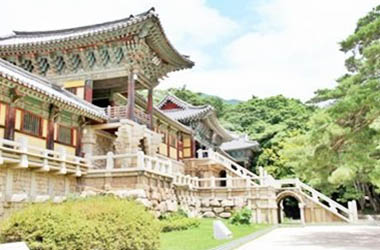
The state ideology of Silla was Buddhism, and its kings also called themselves Buddha. Masterpieces of Buddhist relics in the Oriental World are Bulguksa Temple and Seokguram Grotto, another UNESCO heritage as a duo by themselves. Kimdaeseong, Minister of Treasury, is said to have built and refurbished these splendid architectures from 751 to 774, one of which, Bulguksa, was for respecting and honoring his parents in his present life, and another, Seokguram, was for his parents in a previous life. In the Bulguksa Temple, we search around plenty of treasures and relics. Cheongwoon-gyo and Baekwoon-gyo Bridges are a passage through which we ascend from the Earthly World to the Ideal Buddhist World, and under them, a beautiful pond used to flow around. In front of the Daewoong-jeon(Hall of Great Hero), we can see 2 comparable pagodas called Dabo-tap and Seokga-tap. Dabo-tap Pagoda, standing on the right, symbolizes the Buddha of the Ideal World in the future, and Seoka-tap Pagoda on the left, Sakyamuni or the real Buddha at present. Their architecture can be described with distinctive features of magnitude vs. moderation, complexity vs. simplicity, and romantic vs. classical. In Daewoong-jeon, the main shrine, where 3 golden Buddhas(Sakyamuni, the Great Hero in the middle, past Buddha, and futuristic Buddha) were seated. After walking under colorful lanterns with a wish card and steep stairs, we pass by Museol-jeon, where acknowledged monks give a lecture to common believers. Another shrine is Gwaneum-jeon, where Gwaneum Bodhisattva is depicted as the Goddess of Mercy in a bizarre shape. She has 11 faces, 1,000 eyes, and 1,000 arms, which means this Savior Buddha can appear in varied shapes in front of the needy people, for instance, a doctor for sick people, a food donor for impoverished people. We steer on the left and meet Biro-jeon. At this simple monument, we see the 10 great and other pupil monks who had directly learned from Sakyamuni. On the left side of the building, you can find lots of stone towers. You also try to collect and stack stones to make one for yourself so that you can pray for your own wish. Now we get to Geukrak-jeon, Paradise Hall, where Amitabha is situated in charge of the ideal Paradise of Buddhism. This is a golden, seated statue of Buddha, one of the national treasures. In front of the building is a monument of a golden pig, which was believed in old age to bring humans great luck.
To go to another pair of UNESCO heritage sites, Seokguram Grotto, we go up through a zigzag mountain road with forest trees. This monument has around the same structure as cave prayer rooms found in India, but it is considered the highlight of Buddhist relics in the Oriental World. This grotto was made with very sophisticated and hardworking architectural skills and plans: it has a spring on the ground surface with continuous cool air flowing all the time, so it functions as a natural air conditioning system for protecting the moist, otherwise this in turn could cause moss and corrosion of the granite Buddhist statue and its encircling walls and ceiling. Besides, this marble statue is situated at a position that is directly aligned with the sunrise place on the east on the day of the winter solstice, with a marginal gap of 1/1000 for today’s scientific measuring. A halo phenomenon still happens, the backlight of the Buddha’s head viewed in a straight line by a 160-meter-tall prayer standing in the center of the prayer spot. Even by the far-advanced technology of today, we can not imitate this well-fabricated state. This is why the treasure is enclosed by a glass bin. All this architecture started to be built in 751 AD, the 8th century, and was completed after 20 years’ labor. Most of all, the Buddhist statue itself overlooks us in a majestic and generous facial expression, surrounded by Bodhisattvas and guardians inscribed on the walls. After viewing the beautiful scenery with hills and mountains, we walk down from these mysterious relics and nature.
Now it’s time to taste the featured foods of this local area (Own expense: table d’hote of barbecue such as Tteokgalbi(rib patty), bulgogi(beef seasoned with soy sauce), or Seoksoe bulgogi(grilled Korean beef), or ssambab(meat seasoned with soy sauce or chilli sauce, and eaten wrapped with fresh vegetables). After vernacular dishes, we can take a walk around the grand royal tombs in Daereungwon, which are high-rise in the sky(the biggest one is 23 meters in height, 120 meters in diameter for Hwangnam-daechong), or visit some museums as the Gyeongju National Museum or Cheonma-chong. Just in front of Kyerim, the first king’s natal place in the forest, we drop by Cheomseong-dae, the oldest astronomical and astrological observatory in Asia. Standing alone in a wide open air, this stone pagoda is a structure made in a philosophical, symbolic, and sternly architectural way, so it could withstand an earthquake of 5.8 magnitude without damage.
When it’s the time dusk falls down, we can visit Anapji Pond, which literally means Pond of Ducks and Geese. This section of the old demolished palace, Dong-gung(East Palace) keeps mysterious, different views from one spot to another if it is seen from any place around the pond.
Cheomseongdae is the oldest existing astronomical observatory in Asia. Constructed during the reign of Queen Seon-deok (632-647), it was used for observing the stars in order to forecast the weather. This stone structure is a beautiful combination of straight lines and curves, and was designated as National Treasure No.31. After hearing elegant elegies from this already collapsed but still brilliant dynasty palace and watching its pavilions and scenic views with 4 islets, we wrap up our tour. Gyeongju is still worth visiting in spite of a long ride from Seoul.




JenniferY –
My first trip to Korea and was highly recommended by my friend must visit Gyeongju. A day trip with OneDay Korea Tour was one of the highlight of my Korea trip. Smith (Hong 씨) and Brian (Jeong 씨) was very attentive and also accommodating. Trying to make most of day they took us to top 5 must see UNESCO World Cultural Heritage Landmark in Gyeongju. We visited places such as Yang Dong Folk Village, Bulguksa , Seokguram Grotto and Anapji pond and Cheomseongdae. Beautiful day in September walking in the mountain with fresh air, drank fresh spring water, immerse with past cultures and histories. Both tour guides are friendly,helpful and good conversation and laughter along the way. It was a long day trip but well worth it and I am glad I did it with these guys. I will recommend them to any of my friends. Thanks Smith and Brian for showing my husband and I around Gyeongju. All the best…
Aaron G –
We took this tour and glad that we join the OneDay Korea Tour. We book it 2 days in advance and managed to get 2 great tour guides due to 4hrs driving hours each way from Seoul.
Sarah M –
My father and I took this tour and it was great! We started in Seoul which is about a 4 hour drive to the city. Our driver, Benny, was not only helpful but also hilarious! He helped us find a local restaurant for lunch which met our dietary needs due to food allergies. He was also very flexible when we decided to go to an additional place. Our only regret is that we failed to get a picture with him. Great tour and very quick response on issues and concerns.
Lolit T –
I am a senior citizen and I’m glad that I joined the One Day Korea tour. They give me the comfort, safety and laughter during the trip. I surely will recommend my daughter and friends to join One Day Korea
Pia O –
We are glad to join the Oneday Korea tour. They are so helpful, accomodating, and make us feel the wonderful place of Korea. Our tour guides Terry and Duke is so helpful and always assisting us on our questions even after the tour was over. I highly recommend them!